December 2007
THE LOWE DOWN ON AUDIOBOOKS
by Jonathan Lowe
 What
if a genetically engineered oil-eating virus infected all
the major oil fields in the Middle East and Alaska? That's
the scenario Kyle Mills postulates in his
new novel DARKNESS FALLS, a book with scary
relevance as a cautionary tale. Talk about high concept,
you can't get much higher in terms of consequence for humanity--especially
for the United States, which has a gluttonous relationship
with fossil fuels. The environmental terrorists responsible
for introducing this fictional virus have no idea, either,
to what extent chaos will descend. As an example, while
I write these words I'm sitting in a full service car wash
lobby, and just outside are over a dozen SUVs and trucks
being detailed. Yet even gas for my compact car would become
unavailable, soon after rationing at $12 a gallon expired.
Ground transportation would fail, next. Then grocery stores
would be cleaned out. In the end, most aircraft would be
grounded, except for hospital helicopters sent to shuttle
rich people who were injured defending their cellars from
home invasion. In short, darkness falling would mean a return
to the Dark Ages, when life-spans were brief, and survival
as difficult as making it to the final round of American
Idol. Narrated by actor Erik Steele, who brings an open
and objective sense of surprise to each unfortunate revelation,
the novel plays with its nightmare scenario, making it more
plausible as the plot unfolds. This is not a great book
in the sense of literary style or use of metaphor. Character
development is as limited as other books typical of the
genre. What gives it life and meaning is its relentless
narrative arc, and its uncanny proximity to the unfolding
world energy crisis. Because, like it or not, we are going
to run out of oil as effectively as this, eventually, and
unless someone solves the nuclear waste dilemma (and brings
other alternative energy sources online as well) our grandkids--in
their retirement--will be forced to grow and defend their
own potatoes and green beans. Nevermind cruising the great
capitals of the world, either, because cities will die first,
once transportation--and audiobooks--are gone! As a footnote,
film rights to the novel sold long before publication, based
on its simple premise, and so until seeing is believing,
perhaps listening to the "audio movie" version
starring Erik Steele will inspire more chills than Stephen
King ever could, and give people second thoughts about NASCAR
events or the purchase of vehicles the size of dinosaurs.
(BBC Audiobooks America; 8 1/2 hours unabridged) What
if a genetically engineered oil-eating virus infected all
the major oil fields in the Middle East and Alaska? That's
the scenario Kyle Mills postulates in his
new novel DARKNESS FALLS, a book with scary
relevance as a cautionary tale. Talk about high concept,
you can't get much higher in terms of consequence for humanity--especially
for the United States, which has a gluttonous relationship
with fossil fuels. The environmental terrorists responsible
for introducing this fictional virus have no idea, either,
to what extent chaos will descend. As an example, while
I write these words I'm sitting in a full service car wash
lobby, and just outside are over a dozen SUVs and trucks
being detailed. Yet even gas for my compact car would become
unavailable, soon after rationing at $12 a gallon expired.
Ground transportation would fail, next. Then grocery stores
would be cleaned out. In the end, most aircraft would be
grounded, except for hospital helicopters sent to shuttle
rich people who were injured defending their cellars from
home invasion. In short, darkness falling would mean a return
to the Dark Ages, when life-spans were brief, and survival
as difficult as making it to the final round of American
Idol. Narrated by actor Erik Steele, who brings an open
and objective sense of surprise to each unfortunate revelation,
the novel plays with its nightmare scenario, making it more
plausible as the plot unfolds. This is not a great book
in the sense of literary style or use of metaphor. Character
development is as limited as other books typical of the
genre. What gives it life and meaning is its relentless
narrative arc, and its uncanny proximity to the unfolding
world energy crisis. Because, like it or not, we are going
to run out of oil as effectively as this, eventually, and
unless someone solves the nuclear waste dilemma (and brings
other alternative energy sources online as well) our grandkids--in
their retirement--will be forced to grow and defend their
own potatoes and green beans. Nevermind cruising the great
capitals of the world, either, because cities will die first,
once transportation--and audiobooks--are gone! As a footnote,
film rights to the novel sold long before publication, based
on its simple premise, and so until seeing is believing,
perhaps listening to the "audio movie" version
starring Erik Steele will inspire more chills than Stephen
King ever could, and give people second thoughts about NASCAR
events or the purchase of vehicles the size of dinosaurs.
(BBC Audiobooks America; 8 1/2 hours unabridged) |
 Next,
in imagining what other-worldly civilizations might be like,
we humans like to transpose onto aliens not only some of
our own facial features, but also our ego-maniacal penchant
for conquest, derived (one must assume) from the "glories"
of war. But how likely is it that "advanced" alien
life forms look and think like us? Do they also strap high
explosives around their waists and imagine a heaven filled
with virgins? Do they paint themselves orange or blue, and
scream obscenities from the bleachers whenever someone runs
an oddly shaped inflated cow hide over the wrong goal line?
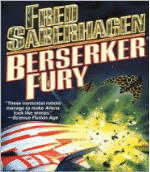
In Fred Saberhagen's BERSERKER
FURY a race of savage androids is intent on the
noble cause of obliterating all life in the galaxy. But
to infiltrate human worlds they first get extreme makeovers
to look like machines we created. Luckily, though, we humans
have cracked their transmission codes, so we're ready for
their final assault. Sound silly? Well, not so fast. Maybe
these androids have the right idea. Maybe they are more
worthy than us to rule the Milky Way. Just what is life,
anyway? Can't a sentient machine win in a debate with an
atheist, after all? God knows there's not enough room out
there for two territorial-obsessed civilizations to coexist,
right? Narrator Paul Michael Garcia has the honor of interpreting
the well drawn characters in this entertaining 1997 novel
just now released on audio. And as long as you don't ask
any deep questions (like I'm doing here), it's solid escapism.
Even if your typical alternative is not actually watching
John Madden rant between truck and fast food commercials.
(Blackstone Audio; 12 1/2 hours unabridged) Next,
in imagining what other-worldly civilizations might be like,
we humans like to transpose onto aliens not only some of
our own facial features, but also our ego-maniacal penchant
for conquest, derived (one must assume) from the "glories"
of war. But how likely is it that "advanced" alien
life forms look and think like us? Do they also strap high
explosives around their waists and imagine a heaven filled
with virgins? Do they paint themselves orange or blue, and
scream obscenities from the bleachers whenever someone runs
an oddly shaped inflated cow hide over the wrong goal line?
In Fred Saberhagen's BERSERKER
FURY a race of savage androids is intent on the
noble cause of obliterating all life in the galaxy. But
to infiltrate human worlds they first get extreme makeovers
to look like machines we created. Luckily, though, we humans
have cracked their transmission codes, so we're ready for
their final assault. Sound silly? Well, not so fast. Maybe
these androids have the right idea. Maybe they are more
worthy than us to rule the Milky Way. Just what is life,
anyway? Can't a sentient machine win in a debate with an
atheist, after all? God knows there's not enough room out
there for two territorial-obsessed civilizations to coexist,
right? Narrator Paul Michael Garcia has the honor of interpreting
the well drawn characters in this entertaining 1997 novel
just now released on audio. And as long as you don't ask
any deep questions (like I'm doing here), it's solid escapism.
Even if your typical alternative is not actually watching
John Madden rant between truck and fast food commercials.
(Blackstone Audio; 12 1/2 hours unabridged) |
 Speaking
of commercials, Americans are getting sick and tired of
being interrupted by them. So they're just ignoring advertising.
Today it's all about interaction, blogs, comments, trends,
word-of-mouth, coffee shops, video games, on-demand programming.
Attention spans are ever shorter, and with so many options
available now, the big old corporations with their bloated
warehouses full of mass produced products can just go to
hell, for all we care! Well, that's according to Seth
Godin in his new book MEATBALL SUNDAE,
anyway, which is about marketing to the new consumer with
the new media. (Merry Christmas, retailers). Stressing being
in sync with the right product married to the right marketing
strategy, Godin says you can't just add the internet (YouTube,
MySpace, Google AdWords, etc) onto things which have no
buzz without them, anymore than you can add meatballs on
top of ice cream and call it "nouveau cuisine."
In the meantime, traditional industries like travel agencies
and middle class grocers are disappearing, too, as everyone
retreats from the middle toward either the high end or the
bargain basement. A revolutionary little tome, this, and
read by the author. (Highbridge Audio; 4 3/4 hours unabridged) Speaking
of commercials, Americans are getting sick and tired of
being interrupted by them. So they're just ignoring advertising.
Today it's all about interaction, blogs, comments, trends,
word-of-mouth, coffee shops, video games, on-demand programming.
Attention spans are ever shorter, and with so many options
available now, the big old corporations with their bloated
warehouses full of mass produced products can just go to
hell, for all we care! Well, that's according to Seth
Godin in his new book MEATBALL SUNDAE,
anyway, which is about marketing to the new consumer with
the new media. (Merry Christmas, retailers). Stressing being
in sync with the right product married to the right marketing
strategy, Godin says you can't just add the internet (YouTube,
MySpace, Google AdWords, etc) onto things which have no
buzz without them, anymore than you can add meatballs on
top of ice cream and call it "nouveau cuisine."
In the meantime, traditional industries like travel agencies
and middle class grocers are disappearing, too, as everyone
retreats from the middle toward either the high end or the
bargain basement. A revolutionary little tome, this, and
read by the author. (Highbridge Audio; 4 3/4 hours unabridged)
|
 Getting
back to sheer mayhem, for most of his career as a mystery
writer James Lee Burke has been turning
over rocks to expose certain creatures of the night whose
cruelty is unbounded. These animals are not separate from
us, however. They share our DNA, and even Burke's main
character--the complex alcoholic detective Dave Robicheaux--almost
crawls under a rock with them before emerging with new
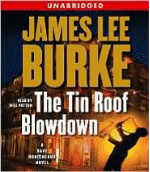
knowledge of himself and the world each time. In THE
TIN ROOF BLOWDOWN, New Orleans is the setting
for Dave's search under Katrina's sodden rocks for a serial
rapist and a vigilante. Although stark and depressing,
we listen to all this for several reasons. One, we're
riveted by Burke's descriptions of place and character,
his original use of metaphor, his regional expertise,
his brilliant insights into the human dilemma. Two, like
true rubber-neckers, we want to see what train wreck has
happened now, and what corpses may litter the highway
next. Finally, there is Will Patton, the perfect narrator
to render Robicheaux, right down to his exhalations of
breath, while nailing the Louisiana accents with masterful
elan. Who could ask for more? Well, actually, I could.
I want Burke to write the Great American Novel. One on
par with The Great Gatsby or the best of Faulkner. I say
this because he's one of the few who could do it. Another
who did it follows. (Simon & Schuster Audio; 16
1/2 hours unabridged) Getting
back to sheer mayhem, for most of his career as a mystery
writer James Lee Burke has been turning
over rocks to expose certain creatures of the night whose
cruelty is unbounded. These animals are not separate from
us, however. They share our DNA, and even Burke's main
character--the complex alcoholic detective Dave Robicheaux--almost
crawls under a rock with them before emerging with new
knowledge of himself and the world each time. In THE
TIN ROOF BLOWDOWN, New Orleans is the setting
for Dave's search under Katrina's sodden rocks for a serial
rapist and a vigilante. Although stark and depressing,
we listen to all this for several reasons. One, we're
riveted by Burke's descriptions of place and character,
his original use of metaphor, his regional expertise,
his brilliant insights into the human dilemma. Two, like
true rubber-neckers, we want to see what train wreck has
happened now, and what corpses may litter the highway
next. Finally, there is Will Patton, the perfect narrator
to render Robicheaux, right down to his exhalations of
breath, while nailing the Louisiana accents with masterful
elan. Who could ask for more? Well, actually, I could.
I want Burke to write the Great American Novel. One on
par with The Great Gatsby or the best of Faulkner. I say
this because he's one of the few who could do it. Another
who did it follows. (Simon & Schuster Audio; 16
1/2 hours unabridged)
|
 Several
years ago, when I interviewed actor Richard Poe, he told
me about the novel INDEPENDENCE DAY,
the Pulitzer Prize winning novel by Richard Ford
that he once narrated. Only recently have I gotten
around to hearing it, and I have to say, I was bowled
over like a final pin for a final spare. Not just by the
story of Frank Bascombe, a self absorbed part time real
estate agent trying to connect with his son, but by how
well Poe's own acting talents and voice meld into creating
that character. This is such a rich and deeply realized
book that I hereby ascribe the words "Great American
Novel" to it without more than a wink's hesitation.
The bonus of hearing it read by Poe, a longtime Broadway
and feature film actor, makes it a keeper. Poe becomes
Bascombe as naturally as Will Patton becomes Dave Robicheaux.
Published in 1995, the novel is a 1998 Recorded Books
title, still available on CD. Also winner of the PEN/Faulkner
award, it's a must-hear for anyone buying or selling a
house, too, since it wryly delves into the real reasons
behind various purchases. And no, it's not just about
price and location. (Recorded Books; 20 hours unabridged) Several
years ago, when I interviewed actor Richard Poe, he told
me about the novel INDEPENDENCE DAY,
the Pulitzer Prize winning novel by Richard Ford
that he once narrated. Only recently have I gotten
around to hearing it, and I have to say, I was bowled
over like a final pin for a final spare. Not just by the
story of Frank Bascombe, a self absorbed part time real
estate agent trying to connect with his son, but by how
well Poe's own acting talents and voice meld into creating
that character. This is such a rich and deeply realized
book that I hereby ascribe the words "Great American
Novel" to it without more than a wink's hesitation.
The bonus of hearing it read by Poe, a longtime Broadway
and feature film actor, makes it a keeper. Poe becomes
Bascombe as naturally as Will Patton becomes Dave Robicheaux.
Published in 1995, the novel is a 1998 Recorded Books
title, still available on CD. Also winner of the PEN/Faulkner
award, it's a must-hear for anyone buying or selling a
house, too, since it wryly delves into the real reasons
behind various purchases. And no, it's not just about
price and location. (Recorded Books; 20 hours unabridged)
|
©
MyShelf.Com. All Rights Reserved. |